Sustainability in Action
In the Spring 2026 issue of the Sustainable Jersey Newsletter:
- Stafford Township Strengthens Coastal Resilience with New Tide Gauge Network (Ocean County)
- Metuchen Schools Take Action To Recover Meals and Eliminate Food Waste (Middlesex County)
- Egg Harbor City Uses Heat Island and Forestry Assessments to Strengthen Climate Resilience (Atlantic County)
- Hillsborough Township Advances Sustainable Water Planning with Gold Star Achievement (Somerset County)
- Remote Net Metering: Expanding Solar Opportunities for Municipalities and Schools
Stafford Township Strengthens Coastal Resilience with New Tide Gauge Network (Ocean County)
As coastal communities face increasing challenges from flooding, storm surge, and sea level rise, access to accurate local data is becoming essential. With support from a $5,000 Sustainable Communities Grant funded by Atlantic City Electric and administered by Sustainable Jersey, Stafford Township has expanded its flood monitoring capabilities through the installation of a second tide gauge in the Beach Haven West lagoon system.
The new gauge builds upon the Township's existing monitoring efforts by providing real-time information on tidal activity and storm surge patterns. Together, the two gauges give municipal officials, emergency responders, and residents a clearer picture of changing water conditions and help support more informed decision-making before, during, and after flooding events.
This project emerged from recommendations identified in the Resilient Stafford Action Plan, a comprehensive framework designed to strengthen the Township's ability to prepare for and respond to flooding, storm surge, and sea level rise. Developed through the New Jersey Department of Environmental Protection's Resilient NJ program, the plan evaluates risks and outlines practical actions to protect residents, infrastructure, and natural resources.
Approximately 8,000 residents in the Beach Haven West section of Stafford Township directly benefit from the enhanced monitoring system. The data collected will support emergency management planning, flood preparedness initiatives, and long-term resiliency planning as the Township works to adapt to changing coastal conditions.
"Tide gauges are foundational to coastal resilience because they provide continuous, real-time tracking of water level changes," explained Dr. Franco Montalto P.E., a professor at Drexel University’s Department of Civil, Architectural and Environmental Engineering and one of the lead investigators in a multi-university, National Oceanic and Atmospheric Administration-funded consortium that helps communities of the northeast prepare for extreme weather. "By measuring storm surges, high tide flooding, and long-term sea level rise, communities can better prepare for and respond to coastal hazards."
The project reflects a collaborative effort among Stafford Township, Drexel University, the Consortium for Climate Risks in the Urban Northeast, the New Jersey Coastal Coalition, the Marine Academy of Technology & Environmental Science (MATES), Save Barnegat Bay, and the Barnegat Bay Partnership. Researchers Dr. Montalto and Dr. Matina Shakya of Drexel University led the installation, working alongside MATES students and Stafford Township Department of Public Works staff.
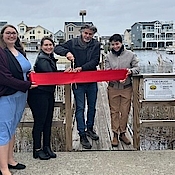
To celebrate the milestone, Mayor Robert Henken and the Stafford Township Council hosted a ribbon-cutting ceremony at the installation site. "As mayor, I have tried to look to the future of the Township with our plans and projects," said Mayor Henken. "This project may not have been possible without a grant like this. We look forward to using the data from the tidal gauge." The tide gauge initiative supports Stafford Township's broader sustainability and resilience efforts, which include water quality improvements, community wellness programs, environmental education, composting workshops, and annual green fair events led by the Stafford Township Green Team. Looking ahead, Stafford Township plans to explore opportunities to expand the tide gauge network to additional flood-prone locations and integrate the resulting data into future resiliency planning and emergency response strategies. Continued partnerships with academic institutions and environmental organizations will help support data analysis, public education, and future funding opportunities. Stafford Township is a Sustainable Jersey silver-certified community. The 2026 Sustainable Communities Grant Program funded by Atlantic City Electric is currently accepting applications. Municipalities served by Atlantic City Electric may apply through July 13, 2026.
Metuchen Schools Take Action To Recover Meals and Eliminate Food Waste (Middlesex County)

Ever wonder what happens to surplus food in school cafeterias? In Metuchen School District, it’s not going to the landfill—it’s helping feed community members in need. Through a comprehensive food waste reduction system that includes food recovery, share tables, environmental education, and community partnerships, the district is tackling one of the most overlooked sustainability challenges facing schools today.
Working with Share My Meals, the First Presbyterian Church of Metuchen food pantry, and the Salvation Army of Elizabeth, Metuchen School District recovers surplus cafeteria food and redirects it to local residents facing food insecurity. From September 2025 through May 2026, the district recovered approximately 4,293 pounds of food, provided 3,410 meals to the community, and prevented 17,624 pounds of CO2 emissions from entering the atmosphere.
Students are at the center of the effort, a priority for the district. They help track and analyze food recovery data, assist with packing and delivering food to the local pantry, and support program communications and outreach. One student reflected on the experience, saying, “I think if more students were able to participate in the food share program like I have, we would have way, way more future environmental scientists to help combat climate change in the future, among other environmental problems.”
Kathryn Lemerich, Secondary STEM Supervisor for Metuchen Public Schools and co-chair of the district’s Sustainability Committee, explained how collaboration across the community helped turn the idea into reality. “One of the things I think is amazing about Metuchen is how willing everybody is to come together and partner,” Lemerich said. “Last year, Superintendent Dr. Vincent Caputo hosted a student advisory board meeting with our cafeteria staff and sustainability efforts came up in the conversation. One of the ideas was creating a share table concept. We were able to build a collaboration across local organizations to recover uneaten meals from our schools.” Lemerich said the initiative also helps students, staff, and the community better understand the connection between food waste and climate change.
Each day, uneaten meals from schools across the district are brought back to the high school, packed into containers provided by Share My Meals, and picked up by community volunteers for delivery to the First Presbyterian Church food pantry and the Salvation Army in Elizabeth. Food waste reduction efforts extend beyond meal recovery. At Metuchen High School, share tables help ensure unopened food items are available to students instead of being discarded. At Edgar Middle School, students operate a “Fruit Stand,” a centrally located, student-led share table stocked daily with uneaten items such as apples, oranges, and bananas. By the end of each school day, the stand is consistently empty—a testament to its value. Younger students are also learning about sustainability through hands-on experiences. All Kindergarten students at Moss School read the book ‘Harlem Grown,’ designed their own garden beds, and then visited the community garden at the First Presbyterian Food Pantry to see how the community garden nourishes the community through the food pantry. Students even grew seedlings for the community garden.
All four schools in the Metuchen School District have achieved Sustainable Jersey for Schools certification, and the district received the 2025 Sustainable Jersey for Schools Green Team Collaboration Award. Lemerich actively shares the district’s expertise through conference presentations and podcasts, including the 2026 New Jersey Sustainability Summit session, “Food Waste Reduction Strategies in New Jersey Schools;” the Sustainable Jersey for Schools panel, “Driving Impact: Energy Savings & Food Waste Reduction Through Sustainable Jersey,” presented at the New Jersey Association for School Business Officials (NJASBO) conference on June 5, 2026; and the Metuchen K12 Food Rescue Podcast. Schools and districts interested in implementing similar initiatives can review the “Reduce, Recover & Recycle Food Waste: A Sustainable Jersey Toolkit for PreK–12 Schools.” .
Egg Harbor City Uses Heat Island and Forestry Assessments to Strengthen Climate Resilience (Atlantic County)
In Egg Harbor City, climate resilience planning is taking root through a coordinated approach that combines science, forestry planning and strategic tree planting. By pairing a newly completed Urban Heat Island Assessment with a Community Forest Management Plan, the city is using data-driven strategies to reduce extreme heat, expand canopy coverage and protect public health.
In July 2025, Egg Harbor City completed an Urban Heat Island Assessment prepared by DelAtlantic Conservation District. The assessment identified areas within the city that experience significantly higher temperatures during the summer months due to urban heat island effects. Urban heat islands occur when built environments absorb and retain more heat than their surroundings because of a lack of vegetation and a concentration of non-reflective buildings and paved surfaces.
These elevated temperatures can have serious consequences for residents, especially vulnerable populations including older adults, young children, outdoor workers and people with chronic illnesses. Extreme heat also increases electricity demand for air conditioning, contributing to higher utility costs and increasing the risk of power outages during heat waves.
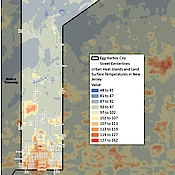
Using GIS mapping technology, the assessment overlaid land surface temperatures with the city’s recently completed tree inventory to identify the locations of heat islands and hot spots throughout Egg Harbor City. Three major heat islands were identified in the city center, the rural transition area and the Egg Harbor North neighborhoods. Additional hot spots were found at Cedar Creek High School, the Egg Harbor City Community School, Charles L. Spragg School and the Public Works garage, all locations with large open spaces and limited canopy cover.
The findings are already shaping action. Egg Harbor City planted 200 trees last fall and plans to plant 250 this year in honor of the 250th anniversary of the Declaration of Independence. The city arborist is currently driving the streets in the identified heat island areas to determine where trees can be planted this fall to reduce heat impacts and expand canopy coverage in the most vulnerable areas. The 2026-2027 tree plantings are made possible through grants from the U.S. Department of Agriculture Forestry Program and the New Jersey Urban and Community Forestry Program.
The city’s Community Forest Management Plan, completed in February 2026, further reinforces this work. The plan includes a comprehensive inventory of public right-of-way trees conducted in 2025 and uses the i-Tree Eco model to calculate the environmental and economic benefits provided by Egg Harbor City’s urban forest. Together, the forestry plan and heat island assessment are helping city leaders prioritize investments where they will have the greatest impact.
One of the plan’s primary goals is to increase overall canopy coverage by 10% through strategic tree planting in under-canopied neighborhoods and corridors. Recommended actions include prioritizing planting zones identified through the heat island assessment, encouraging private landowner participation through education and incentives, and integrating tree planting into infrastructure and streetscape projects.
Led by its green team, SustainableEHC, the city has already organized and funded several model tree projects while continuing to educate residents about the benefits of trees and canopy protection. SustainableEHC is also developing a Heat Island Mitigation Plan that will explore additional cooling strategies, including discouraging black shingle roofs and installing fabric canopies over playgrounds. Other strategies identified in the draft mitigation plan include encouraging business owners to install awnings or shade structures, add tree islands in parking lots, and install green or cool roofs whenever feasible.
"A Heat Island Assessment is a powerful tool that allows municipalities to identify priority areas for tree planting and urban sustainability projects," said Tyler Savage, Forestry Technician with the DelAtlantic Conservation District, who prepared Egg Harbor City’s assessment and is assisting with community forestry and tree-planting grants. "These assessments help communities develop meaningful mitigation strategies that reduce heat island impacts, maximize ecological benefits, and guide municipal investments that strengthen the resilience of urban forests into the future."
In March 2026, the New Jersey Board of Public Utilities (NJBPU) awarded Egg Harbor City funding through New Jersey’s Urban Heat Island Mitigation Program, further supporting the city’s ongoing resilience initiatives. Earlier efforts also included Sustainable Jersey–Atlantic City Electric Sustainable Communities grants, including funding to identify and label 17 tree species in Lincoln Park. Egg Harbor City is also receiving no-cost technical assistance from Sustainable Jersey to complete a Climate Change-Related Hazard Vulnerability Assessment, which includes evaluation of tree canopy and ecosystem services to enhance community resilience. This work is made possible through the New Jersey Department of Environmental Protection’s Resilient NJ Program, with funding from the American Rescue Plan.
Egg Harbor City’s coordinated approach demonstrates how local governments can use assessments and planning tools to create practical, long-term climate resilience strategies that improve public health, strengthen neighborhoods and expand urban tree canopy. Egg Harbor City is a Sustainable Jersey bronze-certified community. Municipalities interested in pursuing similar work can review the Sustainable Jersey Heat Island Assessment and Mitigation Plan and the Community Forestry Management Plan & NJUCF Accreditation actions.
The 2026 Sustainable Communities Grant Program funded by Atlantic City Electric is currently accepting applications. Municipalities served by Atlantic City Electric may apply through July 13, 2026.
Hillsborough Township Advances Sustainable Water Planning with Gold Star Achievement (Somerset County)

Hillsborough Township achieved the Sustainable Jersey Gold Star in Water for its comprehensive Municipal Water Story — a community-driven effort focused on protecting and improving the township’s water resources for generations to come.
Developed through a collaboration between Sustainable Hillsborough and the Rutgers Cooperative Extension Water Resources Program, the Municipal Water Story serves as a detailed inventory of Hillsborough’s water supply, infrastructure, environmental conditions, and community concerns.
More than a technical report, the Water Story was designed to actively engage residents in shaping the future of water stewardship in the community. Through an interactive website, public outreach efforts, and community events, residents were invited to share their experiences and concerns related to flooding, drought, water quality, and conservation. At the township’s 2025 Green Living and Wellness Fair, more than 160 attendees met with members of the Sustainable Hillsborough Committee to discuss the Water Story and provide feedback. Over a one-month period, the online Water Story generated 380 views, 85 comments, and survey participation from residents across the community.
The survey results revealed both challenges and opportunities. Residents identified flooding, boil water advisories, drought conditions, and concerns about contaminants such as PFAS, arsenic, and copper as important local issues. At the same time, the feedback showed a community engaged in water conservation and eager to participate in long-term solutions.
The Municipal Water Story also established a roadmap for action. As part of the Gold Star process, Hillsborough Township developed a “Navigational Path” identifying specific water-related priorities and the steps the municipality will take to address them. These actions are intended to guide steady progress toward a more resilient and sustainable water system.
Kelly Francisco, Ph.D., vice-chair of the Sustainable Hillsborough Committee, presented the township’s water challenges, successes, and future priorities to the Hillsborough Township Committee. The Navigational Path and its requirements were approved by the Township Committee at its December 9, 2025 meeting.
Francisco explained, “Completion of the Water Story, Navigational Path, and associated actions demonstrate Hillsborough Township’s commitment to a sustainable water system. These documents serve as both a pledge and a framework to guide our water-related efforts.” The effort also benefited from the leadership of Rutgers University water specialist Christopher Obropta, Ph.D., P.E., a Hillsborough resident and Environmental Commission member, as well as the contributions of Samantha Ball, Hillsborough Sustainability Program Manager; David Kois, P.P., AICP, Hillsborough Planning Director; Mayor Catherine Payne; and Phil Rudio, Chair of Sustainable Hillsborough.
Former Mayor Robert Britting captured the heart of the initiative by stating, “The Township Committee’s goal is for residents to feel confident that when they turn on their faucet to pour themselves a glass of well water, the water is clean and healthy.”
Hillsborough Township has been a Sustainable Jersey silver-certified community 11 years and holds the distinction of earning two Sustainable Jersey Gold Stars — the Gold Star in Water and the Gold Star in Health. In both 2024 and 2025, Hillsborough Township was also recognized as the recipient of the Sustainability Champion Award for the large population category (40,000 and up). Review the Hillsborough Township Municipal Water Story.
Remote Net Metering: Expanding Solar Opportunities for Municipalities and Schools

For many municipalities and school districts, adding solar energy can be challenging. Historic buildings, shaded roofs, aging infrastructure, or limited space often make it difficult to install solar panels where energy is needed most. New Jersey’s Clean Energy Program Remote Net Metering program offers a flexible solution by allowing public entities to generate solar power at an off-site location and apply the energy credits to municipal or school utility accounts within the same electric utility territory.
The program gives communities greater flexibility in how and where they develop solar projects. A municipality might install solar panels on a Department of Public Works facility, parking lot canopy, a landfill, or even a privately owned site and use the resulting energy savings to offset costs at buildings like a town hall, library, or school with limited solar potential. This approach allows municipalities and school districts to maximize available space while lowering operating costs and advancing sustainability goals.
Projects participating in the program are eligible for incentives through New Jersey’s Successor Solar Incentive (SuSI)-Administratively Determined Incentive (ADI) program and currently receive a Solar Renewable Energy Certificate (SREC)-II value of $90 per megawatt-hour generated. Solar projects can be up to 5 megawatts in size, and applications are reviewed on a first-come, first-served basis until the program’s annual 50-megawatt statewide cap is reached.
As communities continue exploring ways to reduce energy costs and expand renewable energy use, Remote Net Metering offers a practical pathway for making solar work across multiple public facilities. More information about eligibility, program guidelines, and application details is available through the New Jersey’s Clean Energy Program Remote Net Metering page.