Sustainability in Action
In the Summer 2026 issue of the Sustainable Jersey Newsletter:
- Recyclable, Compostable, Reusable, or Trash? Brick Township High School’s Sustain Cycling Project Educates Community (Ocean County)
- Garwood Creates a Safer, More Connected Center Street Corridor (Union County)
- Milltown Public Schools Uses Data-Driven Strategies to Strengthen Its School Community (Middlesex County)
- 346 Trees Take Root Across Morris School District (Morris County)
- Holmdel Township Adds Electric Vehicles and Completes Community Energy Plan (Monmouth County)
Recyclable, Compostable, Reusable, or Trash? Brick Township High School’s Sustain Cycling Project Educates Community (Ocean County)
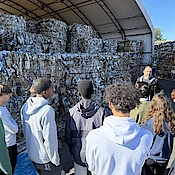
Through their Sustain Cycling initiative, members of the Brick Township High School Green Team launched a community-wide campaign to educate residents about recycling materials that are not accepted in curbside recycling programs, including K-Cup pods, decorations, printer cartridges, light bulbs, dry erase markers, plastic film, batteries, and other hard-to-recycle items.
Supported by a $2,000 Sustainable Jersey for Schools grant funded by the New Jersey Education Association (NJEA), students partnered with Sustainable Brick, the township green team, to raise awareness about the importance of recycling non-mandated materials.
The project included hands-on learning experiences. Accompanied by Brick Mayor Lisa Crate, students toured the Ocean County Recycling Center and the county landfill, gaining firsthand knowledge about how recyclable materials are collected and processed. The visit also demonstrated the environmental benefits of diverting recyclable materials from landfills, helping preserve limited landfill space while protecting local natural resources.
Armed with their knowledge, students worked with their teacher Gary Paxton to research recyclable materials and recycling practices. They used their findings to create a scientific poster and a presentation explaining Brick Township's recycling drop-off options for materials that cannot be placed in single-stream recycling bins. They presented their research to Mayor Lisa Crate, the township's recycling coordinator, and municipal staff before displaying the information for the public at the Annual Brick Township Green Fair.
The students placed collection boxes throughout the high school, including faculty rooms, with clear signage encouraging students and staff to recycle K-Cup pods, dry erase markers, plastic film, and more. Green team members collected and weighed the materials before delivering them to Staples for recycling at the end of the semester. Students reinforced their message through school announcements, educational signage, a website, and social media. They also partnered with the Brick Township Green Team at the Annual Brick Township Green Fair, where they engaged visitors through interactive activities, including a "Recyclable, Compostable, or Trash?" sorting game and a True-or-False food waste challenge.
"Although the students learned that it was difficult for people to change their habits and either save or bring in from home items to be recycled, they figured out ways to better communicate the message," said Brick High School Green Team Advisor Denelle Godek-Johnson. "I believe that the township will see a better recycling rate in the years to come, and our school community saw the investment our students put into helping our community be better stewards."
The project also advanced the school and municipal Sustainable Jersey certification applications. Brick Township High School earned 15 points for completing the Recycling Non-Mandated Materials action. The Township of Brick earned Sustainable Jersey certification points for its partnership through the Green Fair action, illustrating how schools and municipalities can work together. The Sustainable Jersey for Schools 2026 NJEA Grants Cycle is now open. This cycle will award $10,000 project grants to districts and schools and $2,000 grants to support school green teams. Learn more: https://bit.ly/SJSNJEAgrants.
Garwood Creates a Safer, More Connected Center Street Corridor (Union County)
Garwood Borough has transformed Center Street into a safer, more accessible corridor through a series of strategic improvements that encourage walking, bicycling, and safer driving while strengthening connections between neighborhoods, schools, parks, businesses, and public transit.
The initiative began in 2020 when the borough was selected as one of only eight municipalities to participate in the North Jersey Transportation Planning Authority's (NJTPA) Complete Streets Technical Assistance Program. Through a partnership among NJTPA, Sustainable Jersey, and Rutgers University's Voorhees Transportation Center, Garwood received technical assistance to develop a Bicycle Network Plan.
The study identified Center Street as the ideal location for the borough's first major Complete Streets project. As one of Garwood's primary north-south roadways, Center Street links many of the community's key destinations, including the Garwood Train Station, Lincoln Public School, the Garwood Public Library, downtown businesses, Borough Hall, and Unami Park. Together with Walnut Street and the surrounding street network, the corridor provides essential connections between residential neighborhoods, schools, parks, and commercial areas.
To bring the project to life, the borough combined multiple funding sources. A $10,000 Sustainable Jersey grant funded by the PSEG Foundation was paired with a Union County Infrastructure Grant, allowing Garwood to complete the improvements while minimizing the borough's local financial contribution. "Public safety is a top priority in Garwood, and that includes creating safer streets for everyone who walks, bikes, drives, or uses public transit," said Mayor Jen Blumenstock. "The Center Street Corridor Project demonstrates what can be accomplished when residents, community partners, and local government work together toward a common goal."
In summer 2025, Garwood installed six-foot-wide bicycle lanes in both directions along Center Street, creating the borough's first dedicated bicycle corridor. The new lanes provide safer travel for cyclists while improving roadway organization for motorists and increasing visibility for all users.
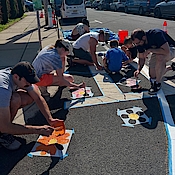
The project also featured "Safer Streets Day," a community demonstration held at the intersection of Center Street and Willow Avenue, one of the borough's busiest pedestrian crossings near the South Side business district. Approximately 25 volunteers joined borough officials, the Garwood Police Department, and EZ Ride, a regional Transportation Management Association (TMA), to create temporary curb bump-outs using paint and flexible delineators. Installed on the northeast and northwest corners of the intersection, the curb extensions demonstrated how the design could slow turning vehicles, improve pedestrian visibility, shorten crossing distances, and reduce conflicts among motorists, cyclists, and pedestrians. The event also gave residents the opportunity to experience a Complete Streets improvement firsthand and provide feedback.
To further support bicycling, three new bicycle racks were installed along the corridor at the Garwood Train Station stairs, the North Avenue bus shelter, and Borough Hall. The Garwood Police Benevolent Association donated all three racks. Community engagement remained a central part of the project. Prior to construction, the borough hosted a Town Hall meeting to present the proposed improvements, explain the benefits of the bicycle lanes, and prepare residents for the installation and the Safer Streets Day demonstration.
Garwood continues to build on this investment by promoting walking, bicycling, and safer transportation throughout the community. The borough also plans to connect these improvements with the expanding Union County Connects bikeway network, creating stronger regional connections and providing residents with transportation options beyond driving. Garwood Borough is a certified Sustainable Jersey municipality.
Milltown Public Schools Uses Data-Driven Strategies to Strengthen Its School Community (Middlesex County)

When students feel safe, connected, and supported, they are better prepared to learn and thrive. Milltown Public Schools is using school climate data to strengthen relationships, guide decision-making, and create learning environments where every student feels a sense of belonging.
Through a comprehensive, data-driven school climate improvement process at Joyce Kilmer School and Parkview School, district leaders are building on existing strengths while identifying opportunities to make their schools even more welcoming and engaging for students, staff, and families.
The district established a District School Climate Team that meets regularly to oversee and implement school climate improvement efforts. The team analyzed feedback from students, staff, and families, developed school-specific action plans, and shared results with the school community to ensure transparency and continuous improvement. "Sustaining a positive school climate requires consistent effort, shared leadership, and a focus on relationships. We’re prioritizing well-being and inclusion at Parkview to ensure everyone thrives," said Amanda Peterson, Parkview School teacher and member of the Parkview Climate Team.
A cornerstone of this work was participation in the New Jersey School Climate Improvement (NJ SCI) Survey, an online assessment that measures perceptions of school safety, relationships, engagement, and overall school climate. Students in grades 4–8, staff, and parents/caregivers all participated in the survey. To encourage broad participation, surveys were made available in multiple languages, distributed through ParentSquare and the district website, and completed during designated times for both students and staff.
Rather than viewing the survey as a one-time assessment, Milltown Public Schools uses the data as an ongoing planning tool. By comparing results year to year, district leaders can identify trends, evaluate the impact of improvement efforts, and refine strategies to better meet the needs of the school community. The survey confirmed several strengths, including students' sense of physical safety, supportive relationships with caring adults, and a strong sense of belonging. The data also identified opportunities to further strengthen student voice, classroom engagement, and perceptions of fairness and shared responsibility within the school community.
“Our recent initiatives have focused on strengthening student voice and belonging, positive relationships, and equitable behavioral expectations. The survey data has helped district leadership make informed decisions and guide future improvement efforts," explained Stephen Andrusko, Joyce Kilmer School science teacher and member of the Joyce Kilmer Climate Team.
Milltown Public Schools is participating in the School Climate Transformation Project, a three-year cohort led by Rutgers University's Graduate School of Applied and Professional Psychology in collaboration with the New Jersey Department of Education. The initiative supports districts in using school climate data to develop evidence-based strategies that improve student well-being and school culture. The work also aligns with New Jersey's requirement that all public schools assess school culture and climate annually.
The district's commitment was also recognized by Sustainable Jersey for Schools. Joyce Kilmer and Parkview Elementary Schools earned 20 Sustainable Jersey for Schools certification points for completing the School Culture and Climate Needs Assessment action. As a result of their sustained efforts, both schools advanced from bronze to silver-level certification in 2026.
346 Trees Take Root Across Morris School District (Morris County)
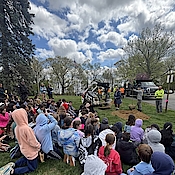
More than 300 new trees are now part of a living landscape that will grow alongside generations of students in the Morris School District. The Morristown Shade Tree Commission partnered with the district to plant approximately 346 trees across four school campuses: Sussex Avenue School, Alexander Hamilton School, Thomas Jefferson School, and Frelinghuysen Middle School.
The project was made possible through the Trees for Schools program, which awarded the Morris School District a $202,400 grant to support planning, site preparation, tree purchases, planting, watering, monitoring, and maintenance over three years.
District officials view the initiative as an investment in student well-being, environmental education, and healthier school campuses. The Morristown Shade Tree Commission contributed its expertise in community forestry, tree planting, maintenance, and public education to help bring the project to life. Together, the partners aim to create more resilient school grounds while establishing a tree canopy that will provide shade, wildlife habitat, cleaner air and long-term carbon sequestration. "This is an exciting and meaningful project for our community, especially for our children," said Mayor Tim Dougherty. "We're proud to be one of the school districts participating in Trees for Schools. This is an investment in our students' environment and education."
Each campus received plantings tailored to its landscape and needs. At Sussex Avenue School, trees are transforming expansive lawn areas into the beginnings of a connected campus canopy. At Thomas Jefferson School, new trees line open lawns and pedestrian circulation areas, providing future shade. Alexander Hamilton School now features trees throughout its side and rear yards, recreation spaces, and gathering areas, creating a more connected landscape. At Frelinghuysen Middle School, trees were planted along pedestrian routes, parking areas, and recreation spaces.
The project also places a strong emphasis on long-term tree care. Dedicated watering equipment enables district staff to provide supplemental irrigation during the critical establishment period, helping the newly planted trees develop strong root systems and increasing their chances of maturing into the healthy, expansive canopy envisioned by the project.
Students are also directly involved in the project, turning the newly planted school grounds into living classrooms. In partnership with district science teachers and Grow It Green Morristown, students participate in site evaluations and planting events and learn how tree species selection and placement affect their school environment. These hands-on experiences connect classroom science with environmental stewardship and the long-term care of their campus trees. Learn more about the project and see the transformation across the four school campuses in the project brochure.
Launched on Arbor Day in 2023, Trees for Schools is a joint initiative of the New Jersey Department of Environmental Protection, Sustainable Jersey, and The College of New Jersey. The program is funded through New Jersey's participation in the Regional Greenhouse Gas Initiative (RGGI). For tree planting guidance, the Sustainable Jersey for Schools Tree Planting action provides a framework for planning school tree-planting projects. It helps school districts consider the costs, logistics, maintenance, and educational value of planting trees while earning certification points.
Holmdel Township Adds Electric Vehicles and Completes Community Energy Plan (Monmouth County)
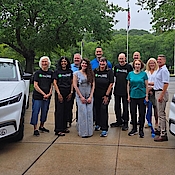
In August, Holmdel Township added its first all-electric vehicles to the municipal fleet, marking another milestone in the community's commitment to sustainability. Members of the Sustainable Holmdel Green Team were joined by Deputy Mayor Brian Foster, Committeeman Gary Vanderham, and Committeeman Greg Buontempo to officially put the township's first electric vehicles into service.
The township recently introduced two Ford Mustang Mach-E vehicles, which have been assigned to the Community Development and Information Technology departments. Holmdel also operates two hybrid police vehicles.
The new electric vehicles advance a key strategy outlined in the township's recently adopted Community Energy Plan. A Sustainable Jersey technical assistance team member worked with township staff and volunteers to develop the plan. Community Energy Plans help municipalities identify opportunities to reduce greenhouse gas emissions and energy use through strategies such as transportation improvements and municipal fleet electrification.
Holmdel Township received a $10,000 grant from the New Jersey Board of Public Utilities, along with technical assistance from Sustainable Jersey, to develop its Community Energy Plan. The Township Committee approved the plan on June 23, 2026. "Our Sustainable Jersey Energy Team contact provided valuable technical support and met with us whenever we had specific questions," said Maryrose Little, co-chair of the Sustainable Holmdel Green Team. "We also received regular emails with resources and deadline reminders. The technical assistance was excellent."
"The purchase of EVs advances a key strategy from our recently adopted Community Energy Plan," said Deputy Mayor Brian Foster. "Fleet electrification reduces fuel and maintenance costs while lowering greenhouse gas emissions, helping create a cleaner and more efficient Holmdel." Holmdel Township is a certified Sustainable Jersey municipality.
Municipalities interested in expanding their use of alternative fuel vehicles can access Sustainable Jersey's Purchasing Resource Center, which help communities compare vehicle options, identify cooperative purchasing opportunities, and locate available EV charging infrastructure. Developed with funding from the New Jersey Board of Public Utilities, these resources connect municipalities with available green technologies and support informed purchasing decisions. New Jersey municipalities and school districts can also receive free energy technical assistance from Sustainable Jersey to help advance energy projects. Learn more about available technical assistance and how to get started: https://bit.ly/SJ_EnergyTechnicalAssistance.
Sustainable Jersey also offers certification actions that provide step-by-step guidance, funding resources, and examples from communities across New Jersey. EV-related actions include Electric Vehicle Community Outreach, Purchase Alternative Fuel Vehicles, Public Electric Vehicle Charging Infrastructure, and Make Your Town Electric Vehicle Friendly. Municipalities can also take advantage of Sustainable Jersey's Alternative Fuel Vehicle Procurement Guide and Community Energy Plan Resources to support fleet electrification and energy planning efforts. Together, these actions and resources help communities integrate transportation initiatives into broader energy strategies and turn long-term planning goals into practical investments.